Key Takeaways
- Tiny exhaust particles act as “seeds” for ice crystal formation.
- Sulfuric acid coatings from fuel sulfur make these particles highly moisture-attracting.
- This allows contrails to form quickly directly behind the engine and persist in drier air than before.
- Trails now commonly last in clear blue skies (~85–95% RHice) whereas pre-1995 those trails would disappear.
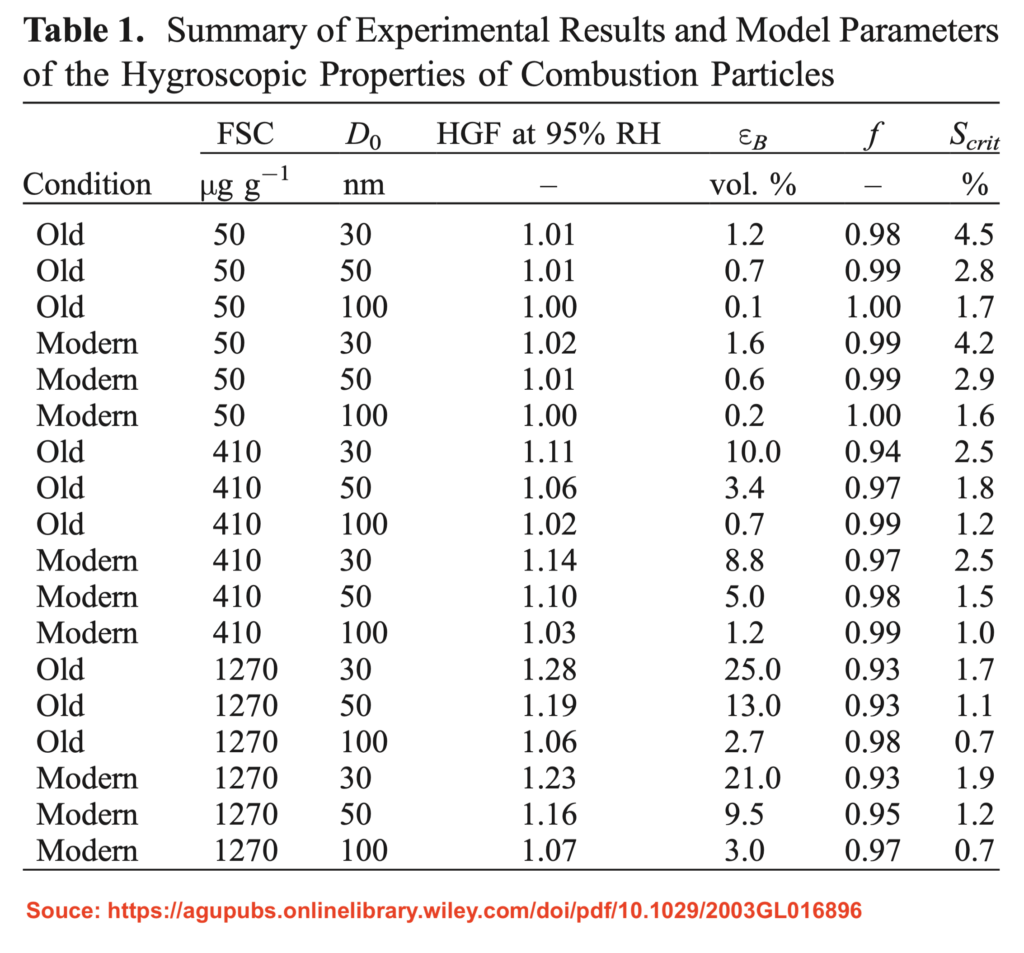
Gysel (2003) measured how jet engine exhaust particles take up water (their hygroscopicity) depending on fuel sulfur content (FSC) and particle size.
They found that higher FSC produced sulfuric acid or sulfate-rich coatings on particle surfaces, increasing water uptake, especially for very small particles.
Small metallic and silicon particles and high sulfur equal more trails.
Overall, this effect was found to enable visible contrails to last longer in subsaturated, clear blue skies.
These findings agree with all theoretical models of particle hygroscopicity.
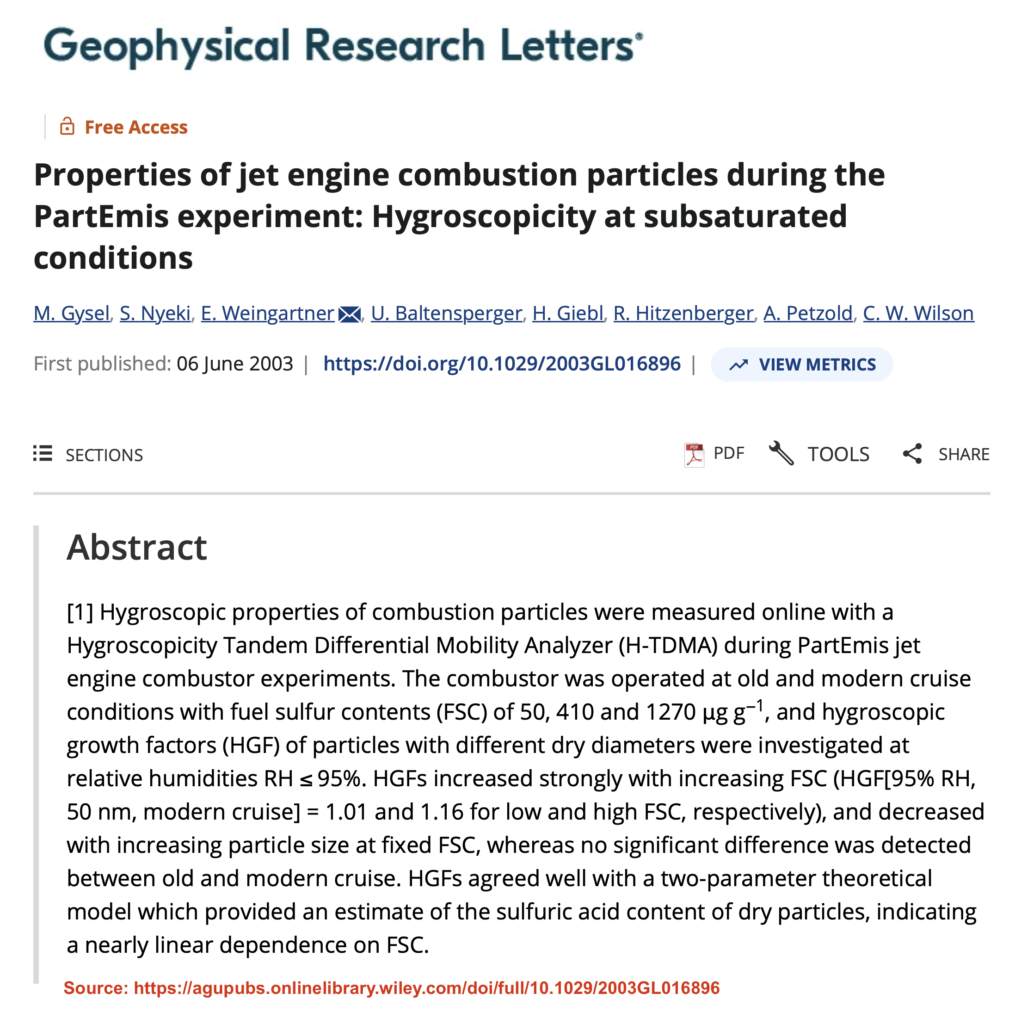
The graph on the right shows experimental evidence of the enhancement effect which high FSC has on trail growth.
It can be seen that the rise in growth rate is directly related to the amount of sulfur in the fuel.
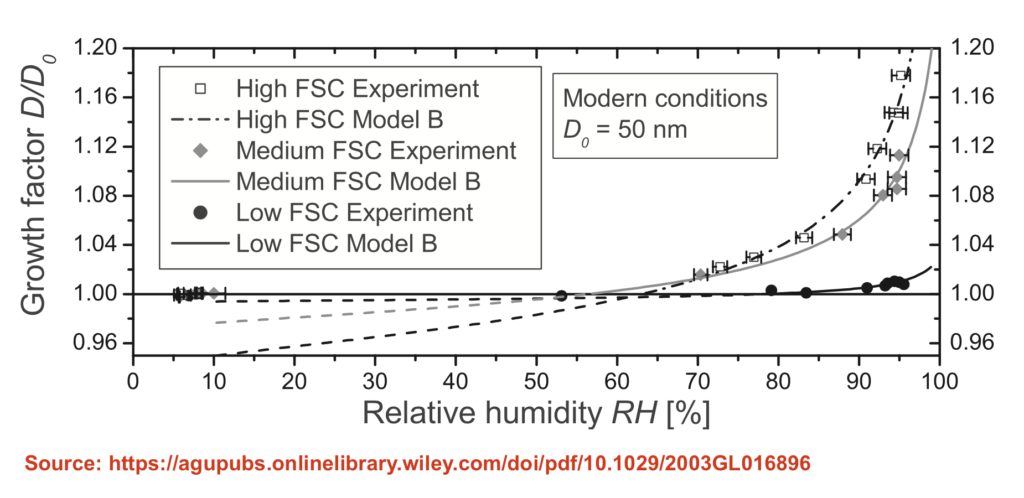
This table summarises the Gysel study:
Importantly, there is no significant difference between old and new engines. New design engines are not the issue.
Smaller, spherical particles with high fuel sulfur content are the most hygroscopic.
Hygroscopic persistence under subsaturated conditions will modify trails and natural cirrus clouds, and contribute to additional cloud formation.
The Gysel study shows that small changes in the mixture of the fuel can have big effects on the trails we see. Trace amounts are very important.
Why Trails Now Last Longer in Clear (Subsaturated) Skies
When a normal ice crystal forms in dry air, it easily loses water molecules back into the air (a process called sublimation). This is why trails would usually disappear quickly in clear blue skies. But when the ice crystals form around sulfuric acid-coated particles, the crystals are more stable. The coating effectively lowers the vapour pressure around the ice crystal. This means the ice doesn’t turn back into vapour (sublimate) as quickly, even when the surrounding air is not fully saturated with moisture.
Result:
The trail can survive and continue growing or spreading in air that is drier than what was previously required. This is why modern persistent trails now commonly form and last for hours in skies that look completely clear and blue, conditions where pre-1990s trails would have vanished within minutes.
NASA SUCCESS Campaign – Evidence of Rapid Early Growth.
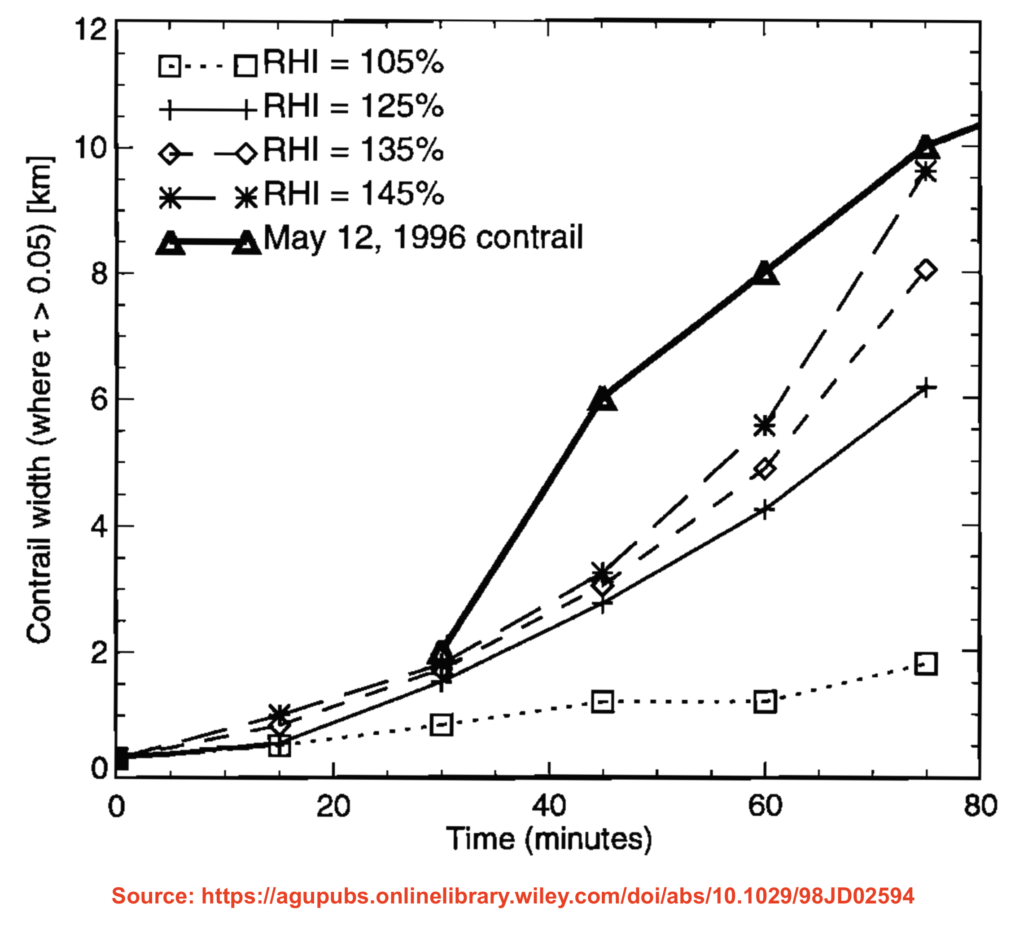
This graph by Jensen (1998, NASA SUCCESS campaign) shows a contrail observed on 12 May 1996, plotted in thick black with triangles.
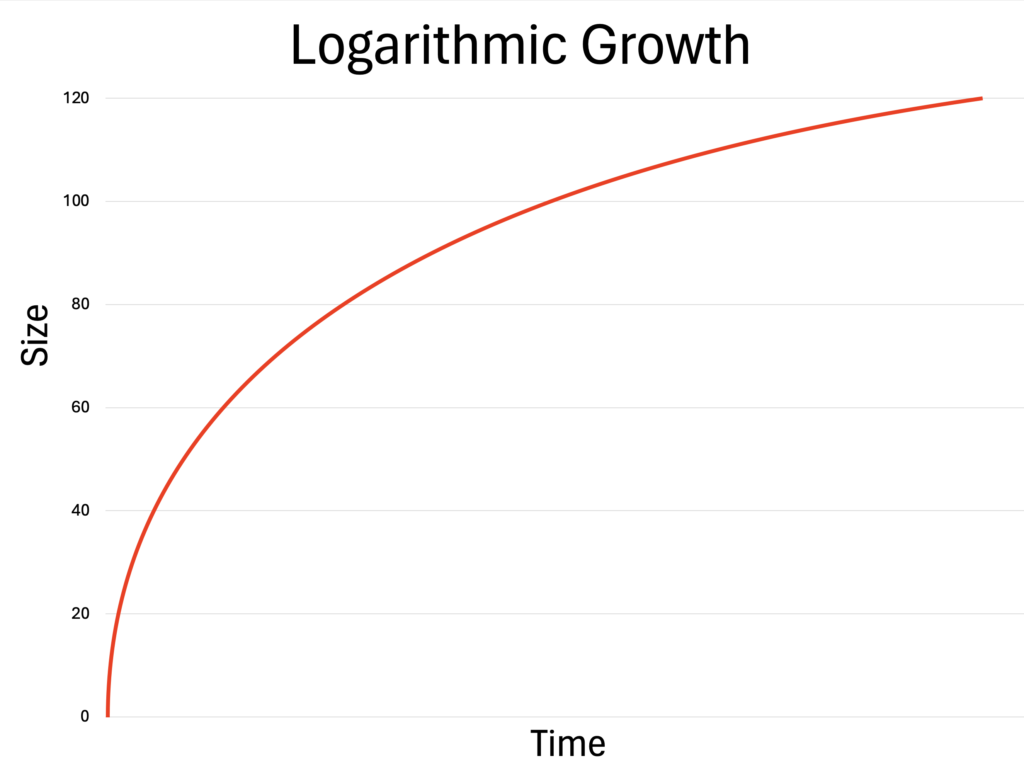
Researchers noted that the trail grew very rapidly in its early stages, a logarithmic growth profile, before slowing down.
This behaviour did not match the standard models shown on the same graph.
The trail was also seen to rise at 10 cm per second.
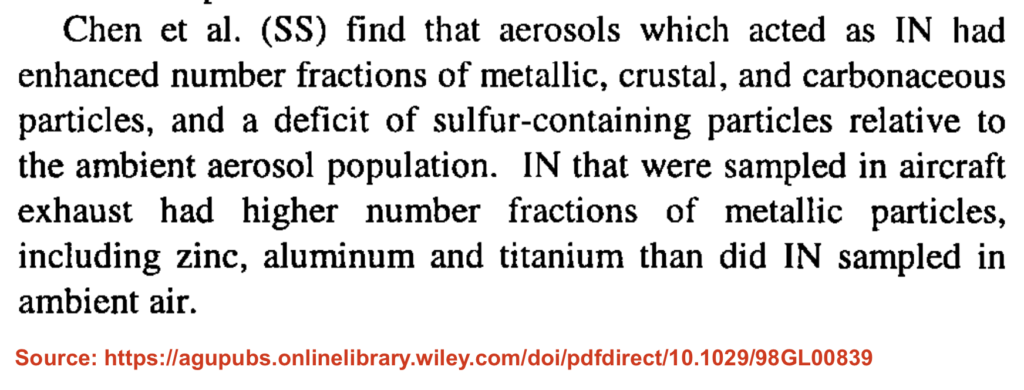
Subsequent analysis by Toon (1998) from the same NASA campaign found that metallic particles made up a significant portion of the ice nuclei in this trail.
Why this matters
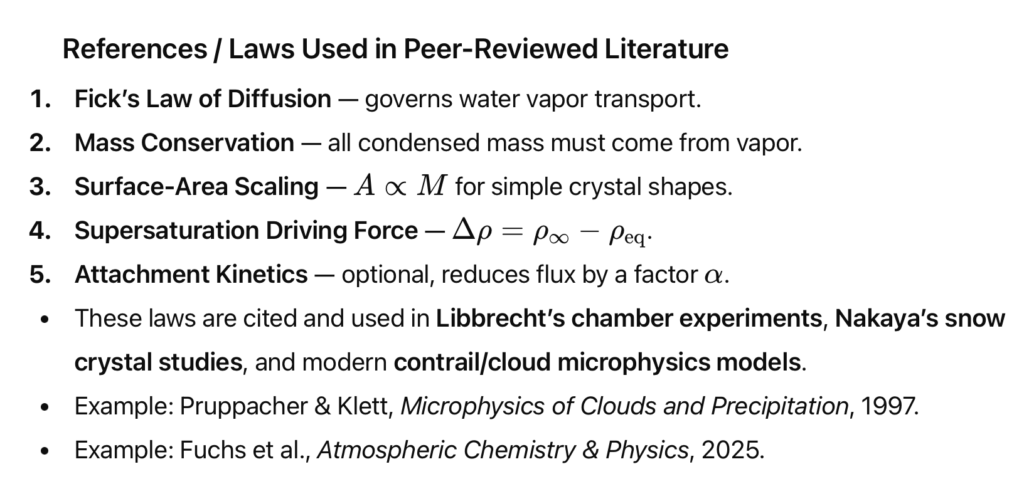
All laws governing the growth of ice crystals and snowflakes predict an exponential growth ptofile.
Normal ice crystals and snowflakes grow exponentially because the more surface area they have, the faster they grow.
Exponential Growth: (typical of natural snow/ice): Growth rate increases as the crystal gets larger.
Logarithmic Growth: (observed in persistent contrails): Fast initial “push” from effective nuclei, then slower growth.
The way modern trails grow is logarithmic, as described in the NASA SUCCESS campaign. They thicken directly behind the plane and then persist/spread, which is consistent with this enhanced nucleation driven by changes in jet fuel composition since the late 1990s.
The tiny sulfur-coated spherical particles are able to scavange the tonnes of water vapour exiting the engines very efficiently because of the turbulent mixing of the air.

The
In contrast, modern observational studies (such as Li 2023) show that persistent contrail cirrus can now last for hours in air that is only about 85–92% RHice. This significant lowering of the effective humidity threshold is due to the hygroscopic particles produced by today’s jet fuel.
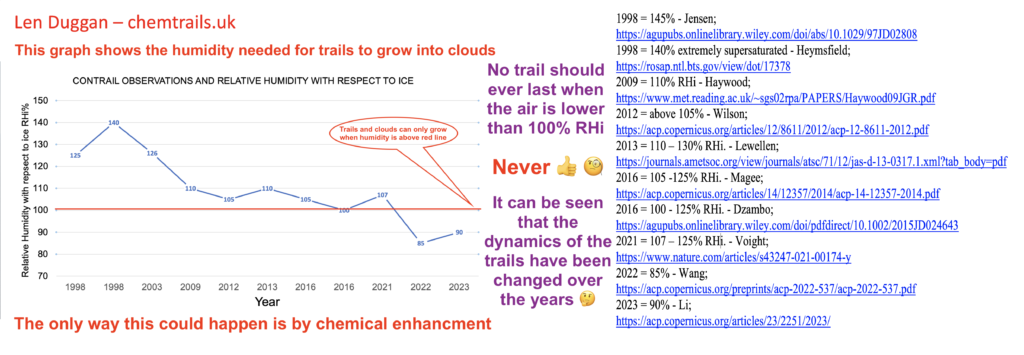
The data for this graph came from 10 science studies that recorded the growth of trails since the 1990s.
The humidity needed for trails to grow has gradually reduced, so they are now able to grow in subsaturated air. Clear blue skies.
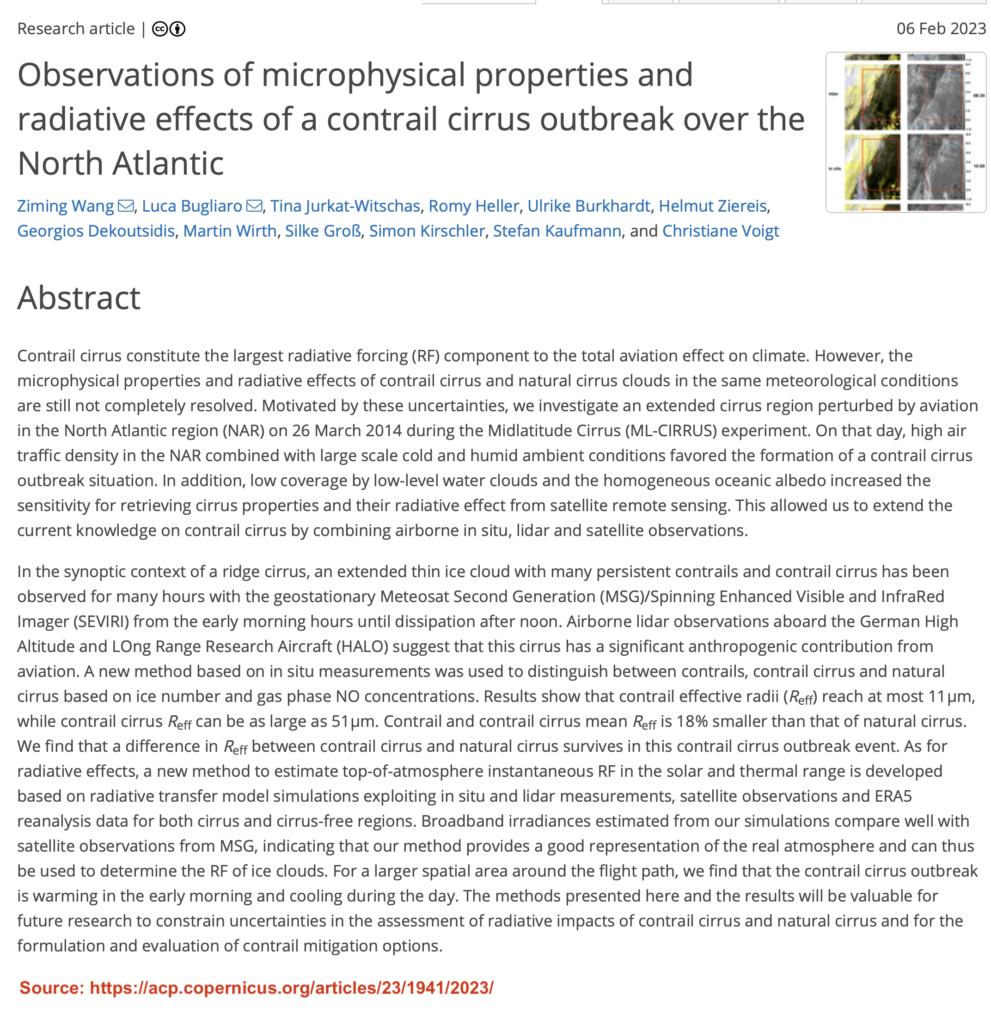
Wang (2023) measured the size of fresh contrails, contrail cirrus, and natural cirrus ice crystals and found contrails to be much smaller than natural cirrus.
Fresh contrails = 8 µm
Contrail cirrus = 22 µm
Natural cirrus = 28 µm
This difference in size is directly related to the smaller size of the ice nuclei on which the ice crystals grow.
All of this further proves that the ice nuclei from jet engines are very small and hygroscopic.
From this information, it can be seen that even though they are present in trace amounts, the metallic elements in the fuel play a big role in making small ice nuclei. Totalling ~100,000,000 per cubic centimetre, at the engine exit.
Jet A1 fuel is used throughout the airline industry, and the super-small particles are made from aluminium, iron, chromium, titanium, and silicon elements in the fuel.
After this, calcium, sodium, manganese, zirconium, and more silicon attach to these small particles to make them grow to about 20 nm.
These small particles are then coated with sulfur, making them extremely hygroscopic and capable of forming trails in subsaturated air, directly behind the engine.
By altering the ratio of small nucleating elements to growth elements, the size of the finished nuclei can be tightly controlled. Just like changing a cake mixture to produce a different-textured cake.
All atmospheric science agrees with this interpretation, even though no single scientific study puts the whole scenario together as one unified understanding. Once it is laid out clearly, it becomes apparent.
All of the science lines up, and it fits perfectly with our observations. Trails now grow in clear blue skies because their growth is controlled by the hygroscopic particles formed of metallic elements, silicon, and sulfur from the fuel.
Increased flight numbers explain more trails on cloudy or humid days, when the air is supersaturated. However, what people notice most are persistent trails forming and spreading across clear blue skies on otherwise cloud-free days. This expansion of trails into subsaturated areas of the sky is driven by changes in jet fuel composition since the late 1990s.
In modern times, the fuel produces more effective ice nuclei in the exhaust. The hygroscopic core doesn’t just slow sublimation, it actually lowers the humidity level at which the ice crystals grow and persist.
Below 100% RHice, the surface of larger crystals shrink away, leaving enough small, core-stabilised crystals to keep the trail visible and spreading for hours. For these small crystals where the core still affects the surface, the balance point shifts from 100% RHice down to roughly 85–95% RHice.
This is why trails can now form and persist in conditions that would have caused contrails to disappear quickly pre-1995.