Key Takeaways
- Small altitude changes (1,000–2,000 ft) or route adjustments can avoid most warming contrails.
- Fewer metals, silicon, and lower sulfur can reduce particle formation, and hygroscopicity.
- Real-world trials (e.g. Google/American Airlines) show significant reductions are achievable.
- The goal is for practical changes, not stopping all visible trails.
Trails not only cause local changes in climate by making a sunny day cloudy, but the black carbon aerosols travel in the stratosphere to have a vast influence over global weather patterns. This is not considered geoengineering because trails are not made for the express purpose of changing the climate; they are a by-product of ordinary airline flights moving passengers and freight. If the same planes flew the same routes without passengers or freight as their purpose, they would be called geoengineering.
This section will discuss mitigation strategies and what can be done to limit the number of trails.
“Avoidance of contrail cirrus cloud” is a well-studied subject. One of the simplest methods is to fly the planes around the humid areas in which trails can be made.
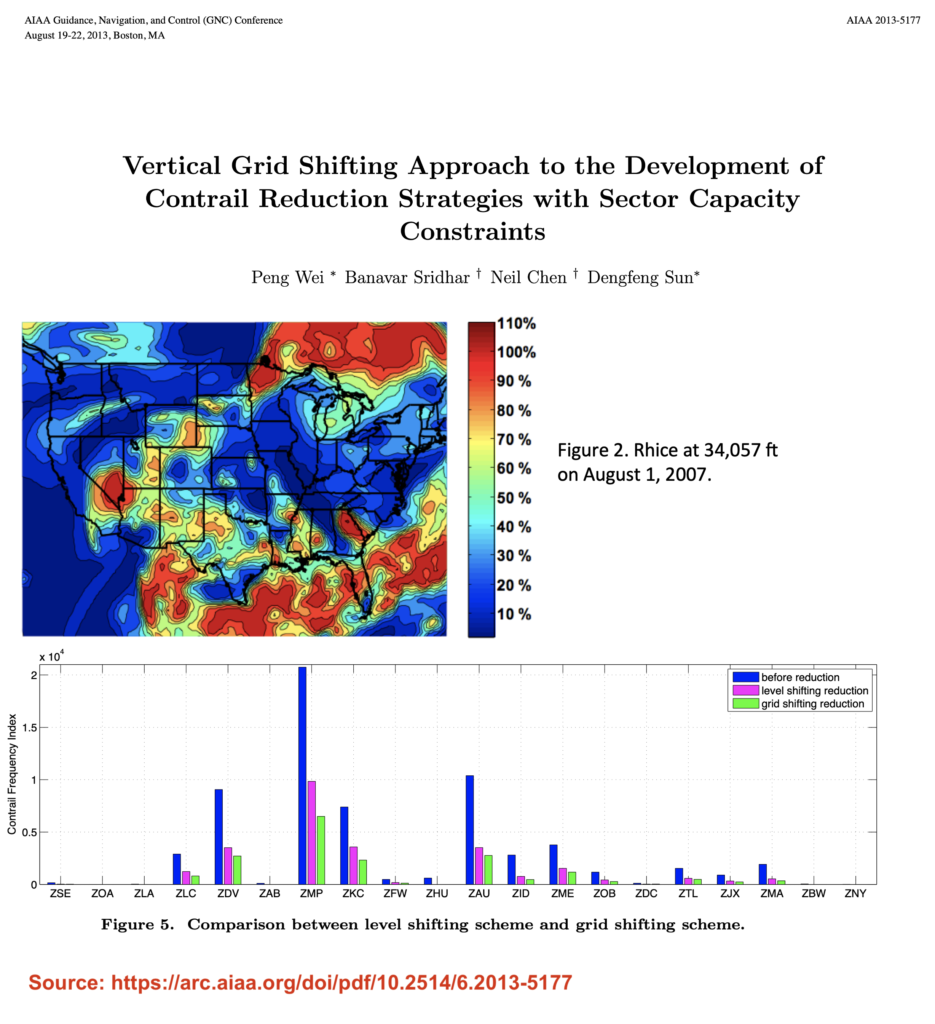
A 2013 study by Wei showed that up to 70% of trails could be avoided by flying planes around humid areas. His “grid shifting” system adjusted the altitude and flight path of individual planes likely to form contrails, rather than changing the routing of the whole fleet.
This approach was more precise and targeted, with minimal disruption to existing flight plans, making it a more efficient and environmentally friendly solution.
The red areas of the map show the relatively small areas of the sky that can make trails, the graph shows the expected savings in trail numbers.
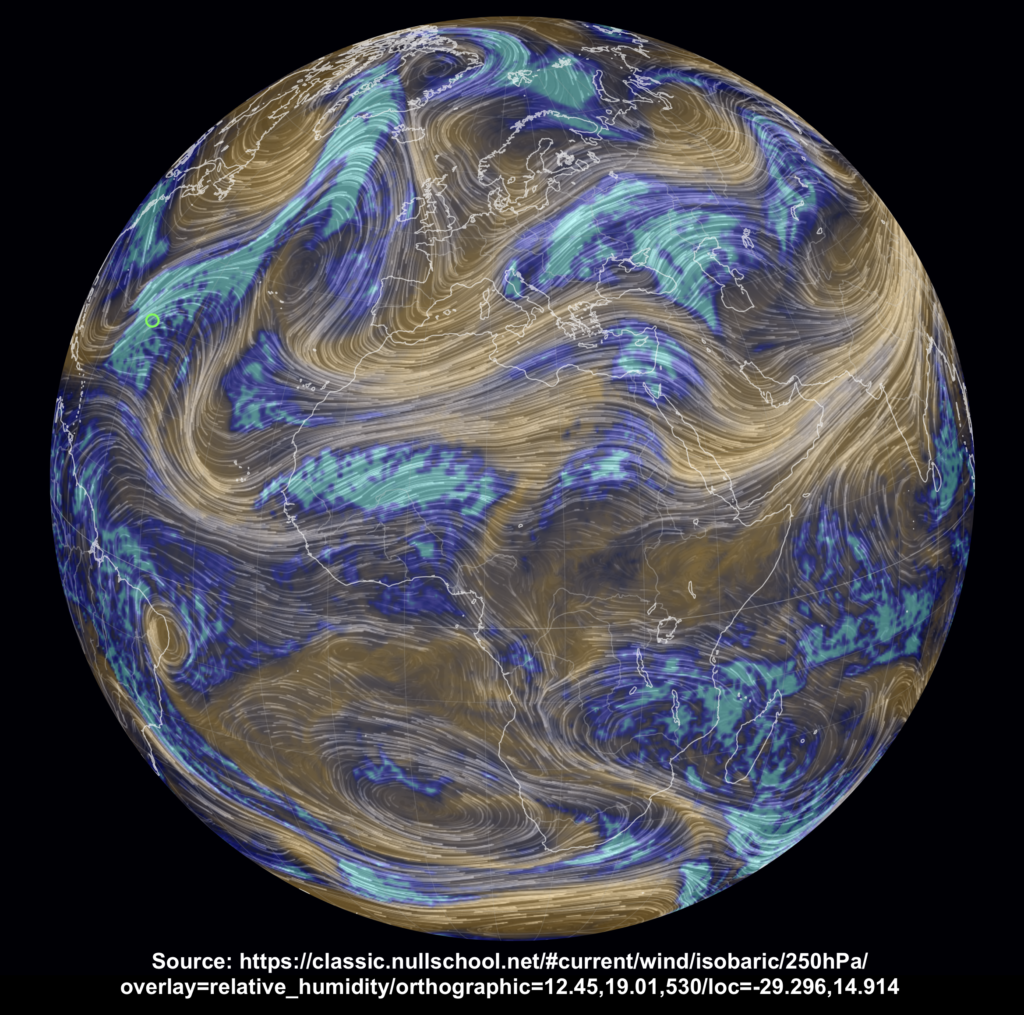
This world map highlights the areas of the sky in light blue, which are saturated and traditionally humid enough to support trail growth.
The dark blue areas are slightly subsaturated and would not traditionally have beeen humid enough to support trail growth. However, it is now possilbe for trails to grow in these subsaturated areas too.
The areas to avoid has got larger, but they can still be avoided using the grid shifting system. They still only represent about 20% of the sky.
The brown areas are far below saturation and can’t support any trails, not even chemtrails.
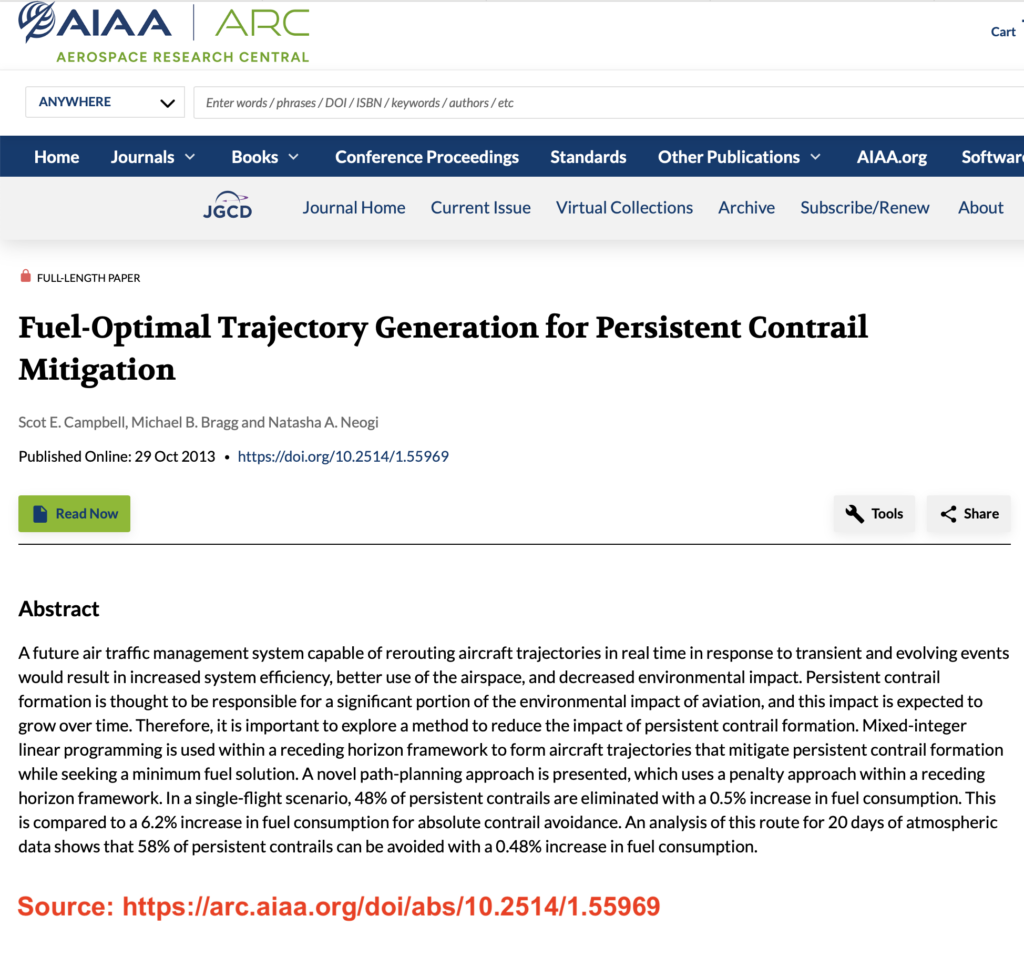
This 2013 study by Campbell investigated the extra fuel used to make changes to flight paths and found that 48% of persistent trails are eliminated with a 0.5% increase in fuel consumption.
Additionally, it was found that for absolute contrail avoidance, fuel consumption increased by only 6.2%.
A 2018 study by Yin investigated transatlantic flights and found route changes returned a reduction of up to 80% in exhaust trail formation.
Routing flights around the humid areas is a much-studied concept.
A 1998 study by Sausen found that a dramatic reduction in contrails would be made if flights were routed either 1 km higher or 1 km lower than the preferred cruising altitude adopted by air traffic.
A 2005 study by Fichter found that lowering flights by 6,000 ft reduced exhaust trails by 60%.
A 2020 study by Teoh identified trails as climate forcing. Teoh’s strategy for mitigation involved rerouting only 15.3% of flights and says their “results show that small changes in flight altitudes are an opportunity for aviation to significantly and rapidly reduce its effect on the climate.”
A 2023 research article by Li found that most trails were produced not in the most saturated areas as expected, but more often in slightly less ice-saturated areas. Leading them to conclude the possibility that larger areas of sky exist in which trails could form.
This explains why we see many trails forming adjacent to naturally occurring cirrus clouds. Thus, extending the natural cloud to encompass vast areas of the sky.
This also confirms the effect of modern jet fuel composition on trail enhancement into subsaturated areas.
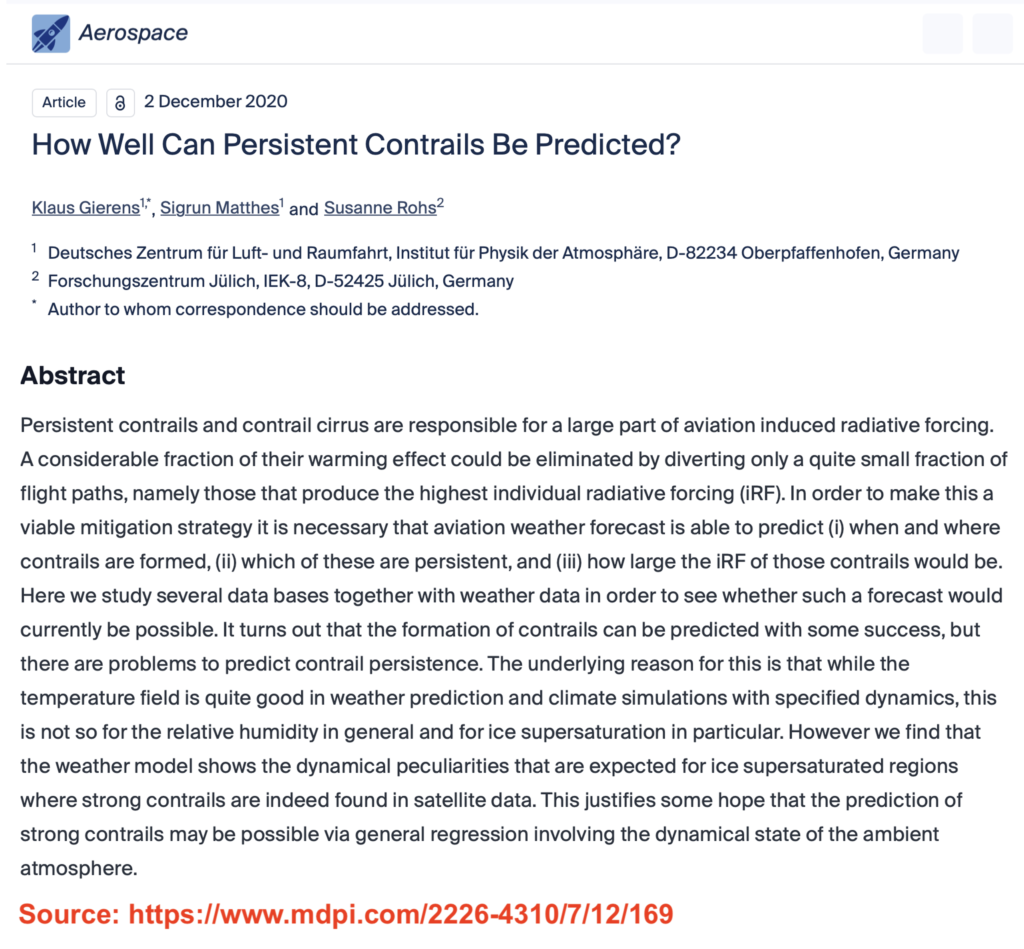
A 2020 study by Gierens found that areas predisposed to trail formation could be accurately identified using weather data readily published.
It confirmed the instrumentation was correct and the weather conditions were correctly measured, but they failed to reliably predict trail formation because they were not considering the ability of trails to form in subsaturated areas.
Similarly, the 2022 study by Moldanova called the OP-FLYKLIM project, and funded by the Swedish Transport Administration’s research and innovation portfolio for aviation, also failed for the same reason.
Why Modern Prediction Models Are Struggling.
Mitigation studies such as Gierens (2020) and Moldanova (2022), commissioned by respected institutions, found it surprisingly difficult to accurately predict when and where persistent contrails would form.
The traditional Schmidt-Appleman criterion has worked well for decades, but it assumes contrails only form and persist in highly ice-supersaturated air. It does not fully account for the hygroscopic particles (especially those coated with sulfuric acid) produced by modern jet fuel.
Recent observational studies, including Wang (2023) and Li (2023), have documented contrail growth and persistence in subsaturated air, conditions where traditional models predict the trails should quickly disappear.
Li (2023) also noted that this expansion into subsaturated skies has made mitigation more challenging. Because trails now form in a wider range of atmospheric conditions, simply rerouting flights around humid areas is less effective than before.
However, targeted routing remains one of the best practical options. Its effectiveness would be greatly increased if combined with changes in fuel composition. Jet A-1 fuel contains two key groups of chemicals that influence ice nuclei:
- Nuclei-forming elements: aluminium, iron, chromium, titanium, and silicon.
- Particle growth-enhancing elements: calcium, magnesium, sodium, manganese, and zirconium. Silicon also contributes to the growth of particles.
Sulfur in the fuel provides the critical activation coating that makes these particles highly hygroscopic. By adjusting the ratios of these substances, particularly by reducing certain metals, silicon, and sulfur content, it is possible to control the number and effectiveness of ice nuclei produced by the engine. This could significantly reduce the formation and persistence of modern trails.