- Jet fuel is mostly kerosene but contains trace metals, sulfur, and silicon from refining.
- Since the late 1990s, more cracking and coking of heavier crudes has increased these trace elements.
- These traces become millions of microscopic particles in the exhaust.
- Small changes in fuel composition have a big effect on trail behaviour.
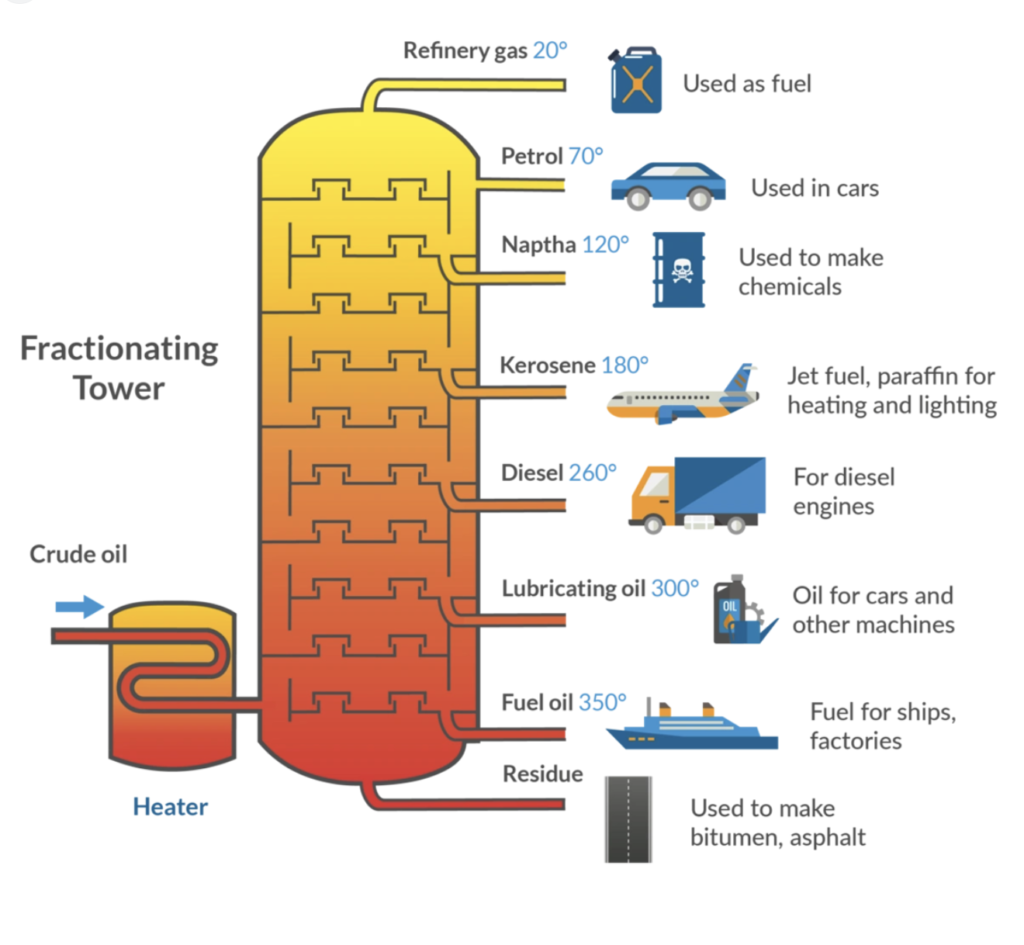
Distillation and Purity of Jet Fuel
Distillation is a physical separation process, meaning it doesn’t change the chemical structure of hydrocarbons. It simply sorts them based on the temperature of their boiling points.
When crude oil is distilled, jet fuel emerges as one of the fractions in the kerosene range.
Jet fuel is a mixture of hydrocarbons within this temperature range, and it contains relatively few impurities. Distillation produces a clean, high-quality fuel directly from the process.
Processing Heavy Residuals
After distillation, low-value heavy residuals remain at the bottom of the column. These also contain the impurities excluded by the distillation process.
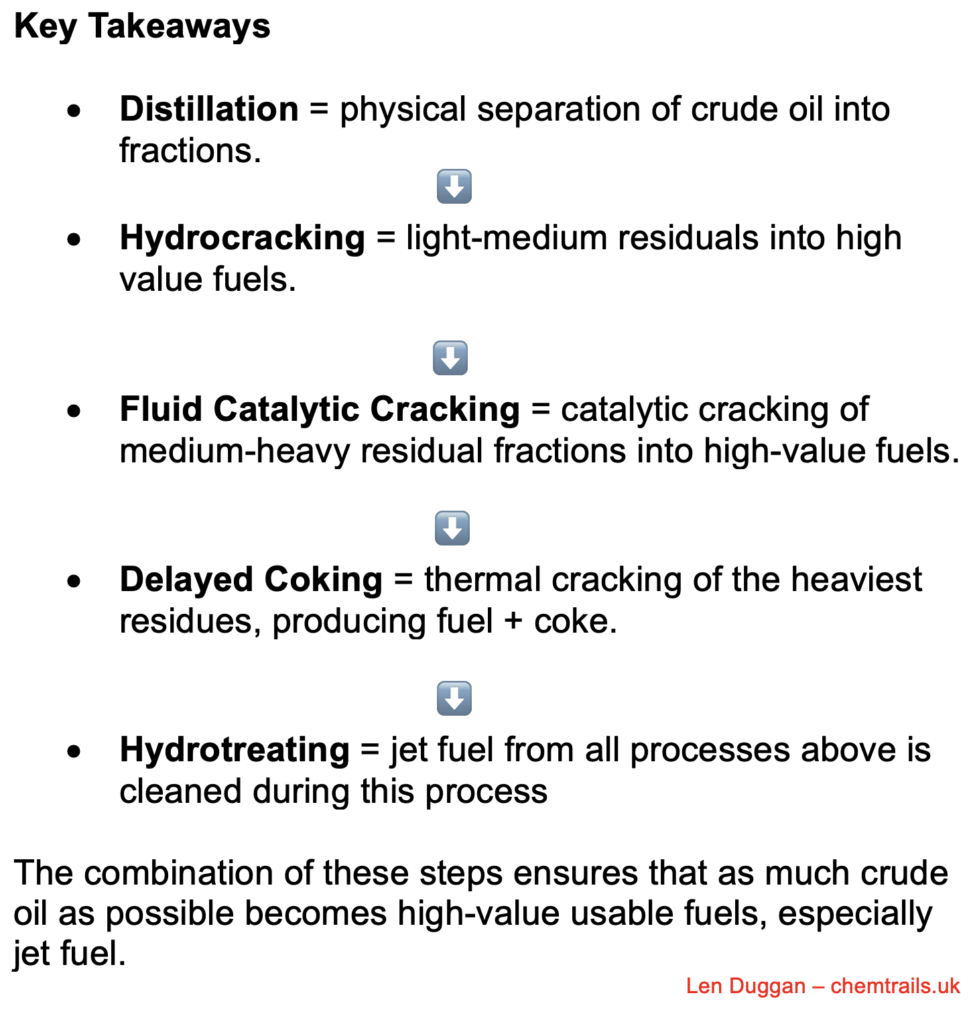
The heavy low-value residuals, which would otherwise make bitumen and asphalt, are further processed depending on their quality:
Lighter fractions are processed using hydrocracking, which also produces a relatively contaminant-free jet fuel.
Medium fractions go through Fluid Catalytic Cracking (FCC), which can break down the low-quality residuals into high-value jet fuels, gasoline, and diesel.
Heavier fractions of the residual go through a Delayed Coking Unit, which thermally cracks the very heavy fractions, producing additional high-value fuels (including jet fuel) and solid petroleum coke as a by-product.
These additional processing steps ensure the maximum recovery of valuable fuels from the crude oil, but they also introduce metallic and silicon contaminants into the jet fuel reservoir.
Impurities and Their Source
A key point is that almost all impurities in crude oil remain concentrated in the heavy residuals at the bottom of the distillation column.
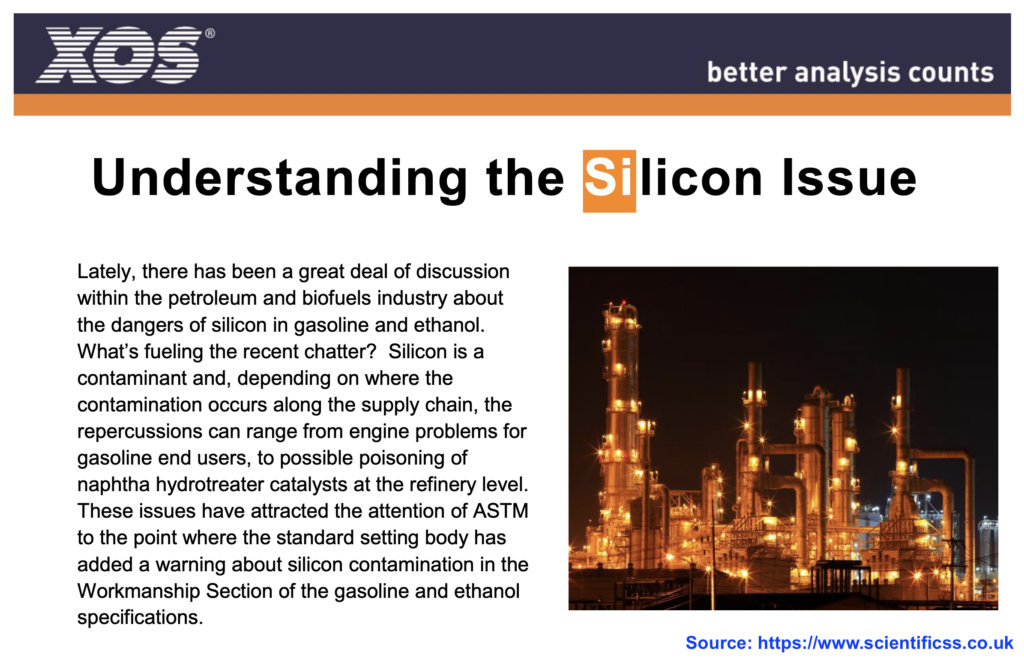
As a result, fuel made from these additional processes includes metallic elements and silicon (from antifoaming agents) used in the cracking and coking processes.
Sulfur is typically allowed when less than 0.3% by weight.
Even though the fuel is further refined by the hydrotreating process, contamination can never be totally eliminated.
Blending of Jet Fuel
Jet fuel from cracking and coking origins is mixed in small, controlled amounts with the distilled kerosene to produce the final commercial jet fuel mix.
Refiners carefully manage the ratios of cracked/coked jet fuel in the mix to ensure the regulations are maintained to avoid spoilage.
This blending is monitored precisely, so even though these blends contain higher levels of impurities, the final fuel still meets strict aviation standards. Refiners know the ratios so they do not spoil a batch and lessen their profits.
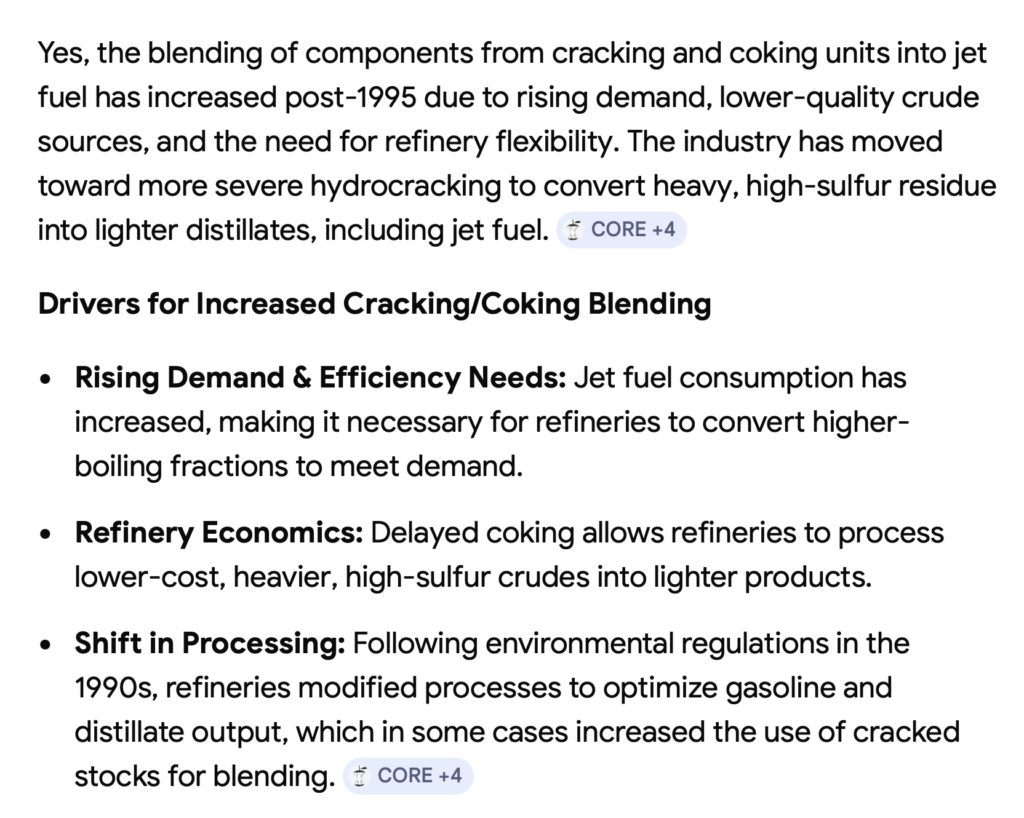
When asking AI, “Jet fuel cracking and coking blending increased after 1995,” the evidence of jet fuel changes is easy to find.
A 1995 study by Elliot explains how “delayed coking” has an increasing role to play in jet fuel.
A 2024 article by Kristen Hays explains that “More than a decade ago, several U.S refiners brought new hydrocracking capacity online, wagering that rising demand for middle distillates made such major investments necessary.
Role of MDA (Metal Deactivator Additives) – coordination complexes
The final blended jet fuel contains trace amounts of metallic impurities from the cracking and coking fractions. These metals cause unwanted chemical reactions in storage and during combustion, leading to deposits and corrosion of the engines.
To counteract this, metal deactivator additives (MDA) are added to jet fuel. These MDAs bind to the metallic ions, forming coordination complexes. This renders the metals inactive and prevents any engine issues from oxidation of the fuel, sludge or deposits, and ensures the fuel burns cleanly and safely.
MDAs allow trace amounts of metals from the cracking and coking processes to pass safely through aircraft engines without causing damage.
Polydimethylsiloxane (PDMS) – Defoaming Additive and Source of Silicon
Polydimethylsiloxane (PDMS) is an antifoaming agent used extensively in refinery operations to prevent foam formation during high‑speed pumping and vigorous fluid flow. It does not enter the fuel during the distillation process.
PDMS is used at much higher levels in the coking and cracking phases, and some of the silicon from these processes contaminates the finished jet fuel.
The fuel make-up has been studied in great depth by science. The refinery contaminants and additives have all been logged and categorised in every way possible; little is left to the imagination regarding jet fuel make-up.
An example is the 2000 report by Shumway, which lists the trace elements in jet fuel.
Four samples of jet aviation fuel were collected and analysed for a broad range of elements
It was noted that there were substantial differences in the levels of trace elements depending on the origin of the fuel.
Even though the numbers are not always consistent, we know these elements are in the fuel at varying levels.
The existence of metallic elements in jet fuel cannot be denied.
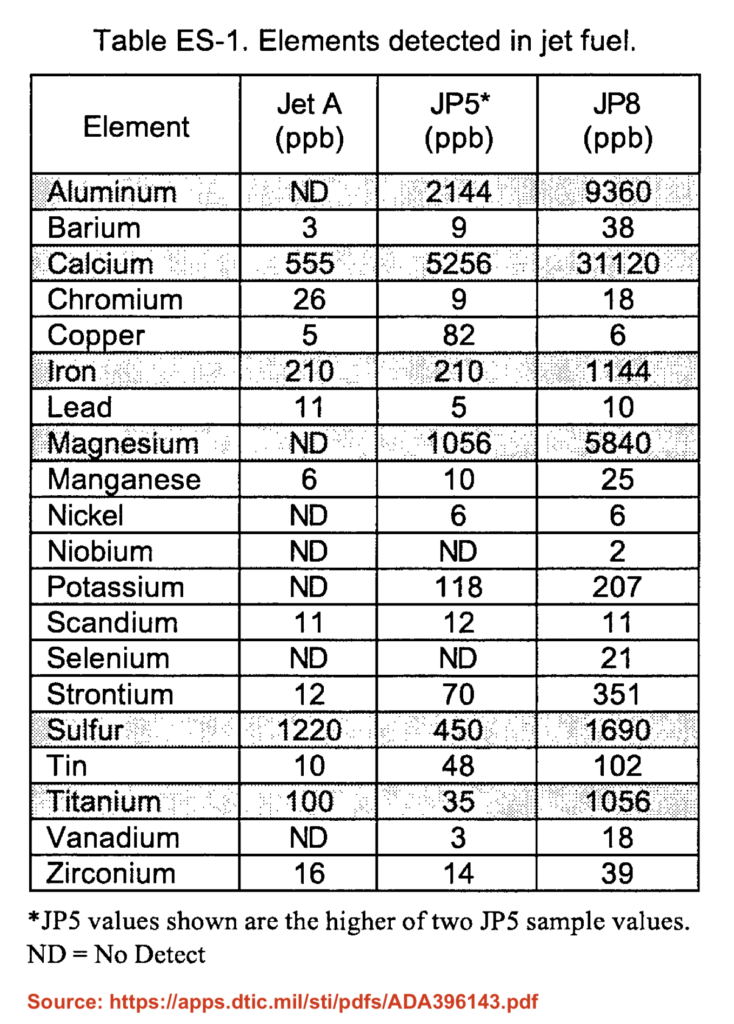
Jet fuel contains trace amounts of metallic elements, silicon, and sulfur because these compounds are introduced when fuel produced from the cracking and coking of heavy residues is blended with distilled jet fuel.
BP explains that samples taken at different stages of the fuel’s journey to the aircraft will change the fuel’s profile.
These contaminants are present in ppb, but trace amounts do not mean insignificant numbers.
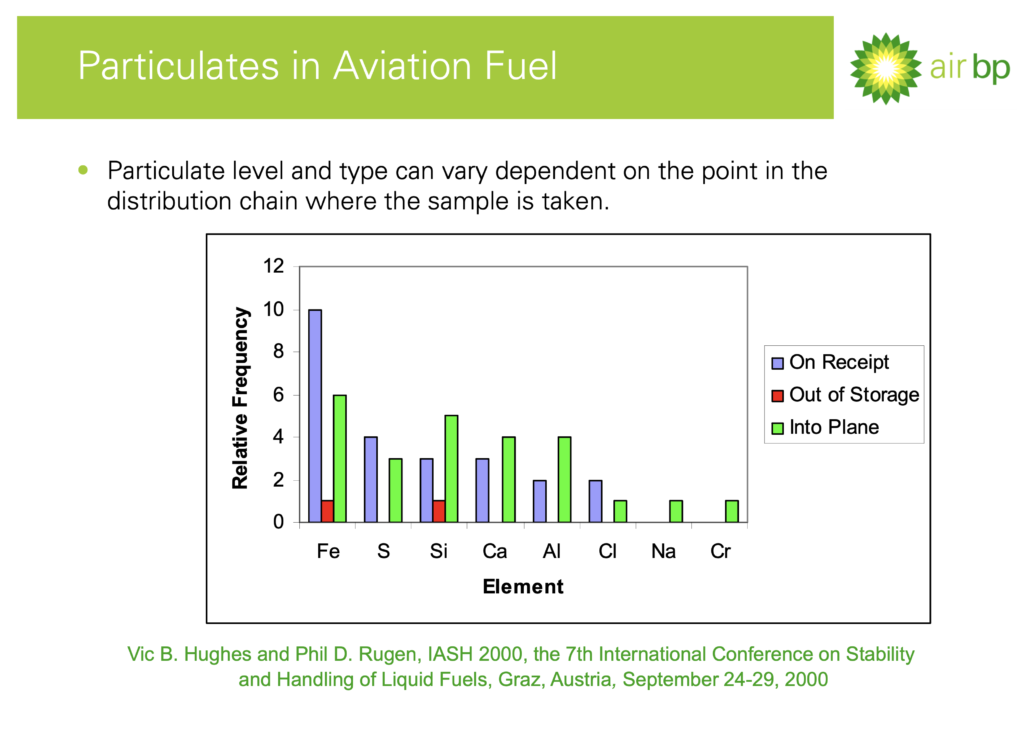
At the airport, if the fuel fails the JFTOT (Jet Fuel Thermal Oxidation Test) due to trace metal contamination, Metal Deactivator Additive (MDA) may be added to bind the metal ions and prevent them from causing fuel degradation.
Some people will say that these contaminations make no difference because they are only trace amounts, but that is because they do not understand how many atoms are represented by those “trace” amounts.
Trace amounts are small, but the engine burns 800 grams of fuel per second, producing 100,000,000 metallic hygroscopic ice nuclei /cm3.