Key Takeaways
- Jet engines produce huge amounts of water vapour (1.24 times the fuel burned) plus tiny particles.
- Exhaust contains two main particle types: larger carbonaceous soot and tiny metallic/silicon spheres.
- The tiny spherical particles dominate trail formation because they are highly hygroscopic.
- Modern fuel creates more effective ice nuclei than older fuel.
We often think of burning as destroying something, because after a fire, we usually only see a small pile of ash left behind, so it feels like most of it has disappeared. What we don’t see is that most of the burnt material doesn’t turn into ash; it turns into invisible gases that float away into the air. When something burns, it isn’t vanishing or being destroyed. Oxygen from the air joins with the material, changing it into new substances like gases and ash. Even though it looks like there is less left, the total amount of material after burning is actually greater than what you started with, because oxygen from the air has actually been added by the chemistry of the fire.
Jet fuel contains trace amounts of substances such as metals, sulfur, and silicon. Even though they are trace amounts, the extreme temperatures inside a jet engine transform them into a vast number of tiny particles as the exhaust leaves the engine. In fact, this process creates tens of millions of metallic particles in every cubic centimetre of exhaust.
As the exhaust exits the engine, temperatures drop; the first materials to condense are those with the highest boiling points, primarily metals. These begin forming tiny solid or liquid clusters immediately at the engine exit. You can think of these as the first “seeds” of particles forming in the exhaust plume.
These are quickly coated by other solids after collisions to grow to 20 nm particles with onion-like layers. Silicon becomes 60% of the particle mass.
From combustion, the exhaust also contains larger, irregularly shaped carbonaceous particles. These particles are more numerous than the small spherical particles, but they are relatively inactive and play a minor role in the evolution of trails into clouds.
As the exhaust cools further, sulfur dioxide produced during combustion is chemically transformed into sulfuric acid. This sulfuric acid only exists briefly in vapour form because it has a very high boiling point. Once formed, it rapidly condenses onto the abundant ultrafine particles already present in the plume. Sulfuric acid is extremely non-volatile, like a thick syrup, so as soon as it forms in the cooling plume, it leaves the gas phase and sticks to particles.
Once the particles become coated with sulfuric acid, they become highly effective at attracting water.
As cooling continues, water vapour in the exhaust begins to condense. Because there are millions of these tiny sulfur-coated particles, and because they are highly effective at attracting moisture, they rapidly scavenge the water vapour from the engine and form tiny droplets before the water vapour has a chance to dissipate into the surrounding air.
Further cooling takes the water droplets into the ice phase. After this, the trail grows by attracting the humidity of the surrounding air, but it is already very large.
This is why modern trails grow so effectively.
Even in air that would normally cause ice to evaporate, these hygroscopic particles can hold onto water more effectively, helping the trail to persist longer than it otherwise would.
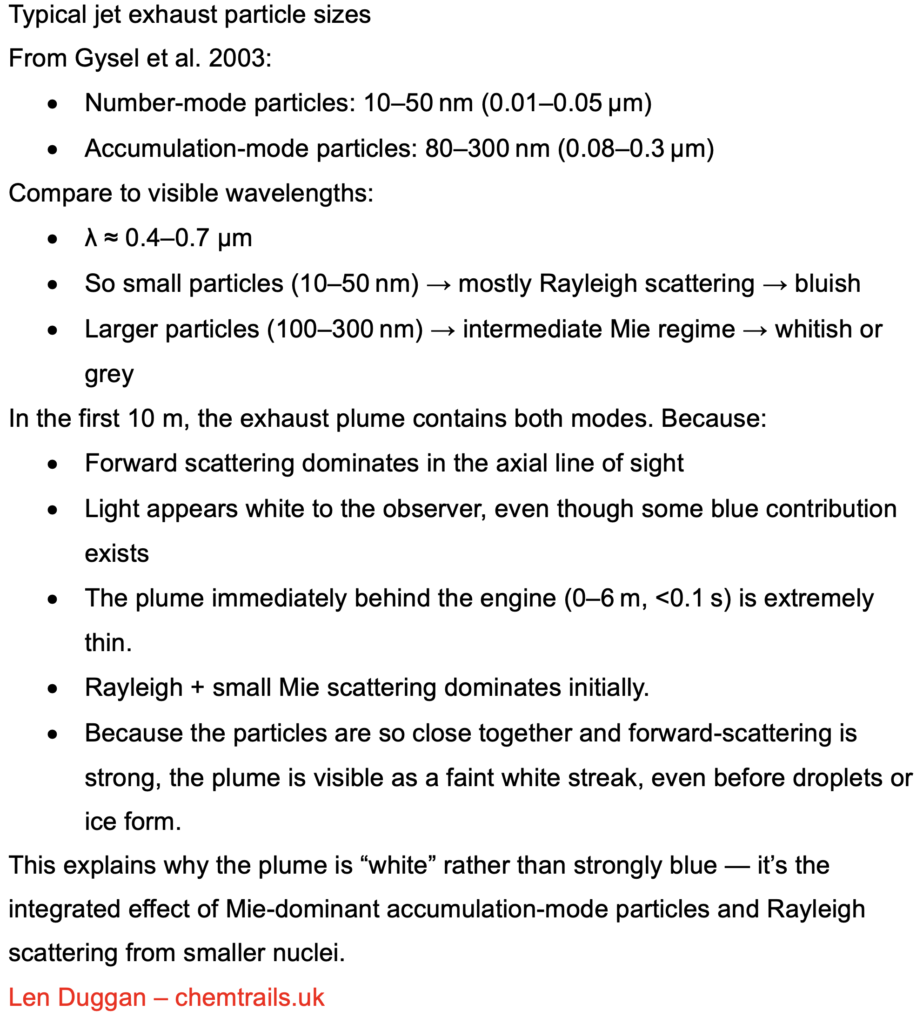
In Jet A1 fuel, the elements Al, Fe, Cr, Si, Ni, Va, and Ti form the first tiny sub-micron spheres, and they are built upon by Si, Ca, Mg, Na, Mn, and Zr.
When the spheres are small, they produce a bluish scattering of light called Rayleigh scattering.
As the particles get above 100 nm, they produce Mie scattering, which we see as a whitish-grey colour. We see the light as white, even though it has a tint of blue.
You are not seeing smoke, water droplets, or ice.
You are seeing the light reflecting off the metallic-based spheres after the additive part of the metallic coordination complexes is burnt away.
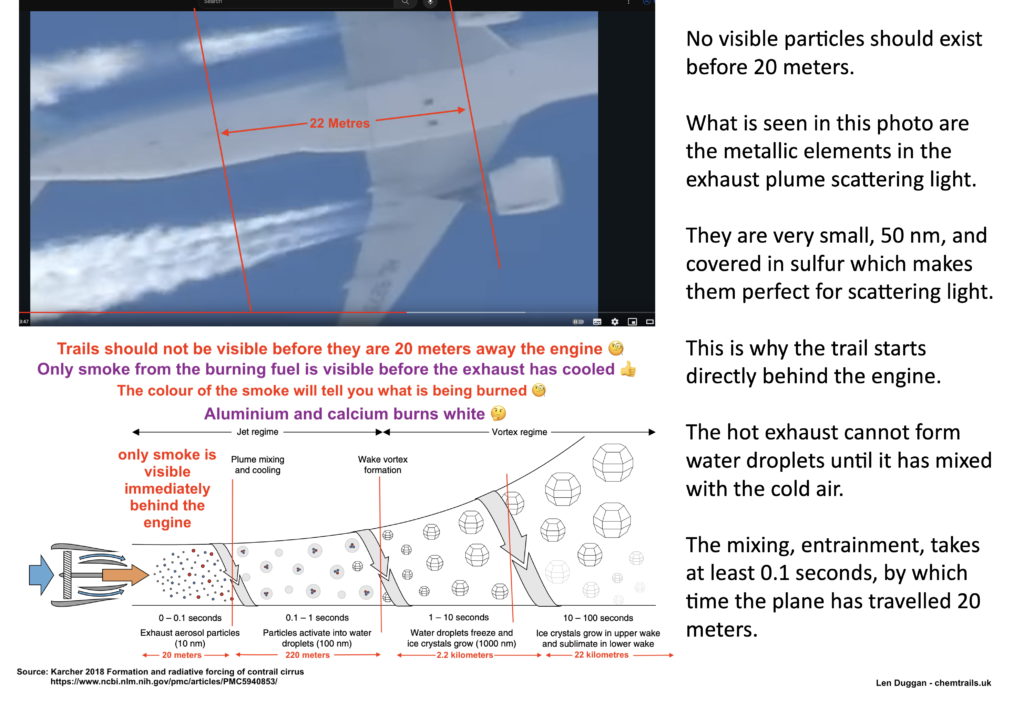
Including all the metallic elements, the engine produces 100,000,000 metallic hygroscopic ice nuclei per cubic centimetre.
Even over a few meters, there are trillions of scattering centres per cubic centimetre contributing to the integrated brightness
You can see the metallic ice nuclei directly behind the engine because they are the perfect size to scatter light.
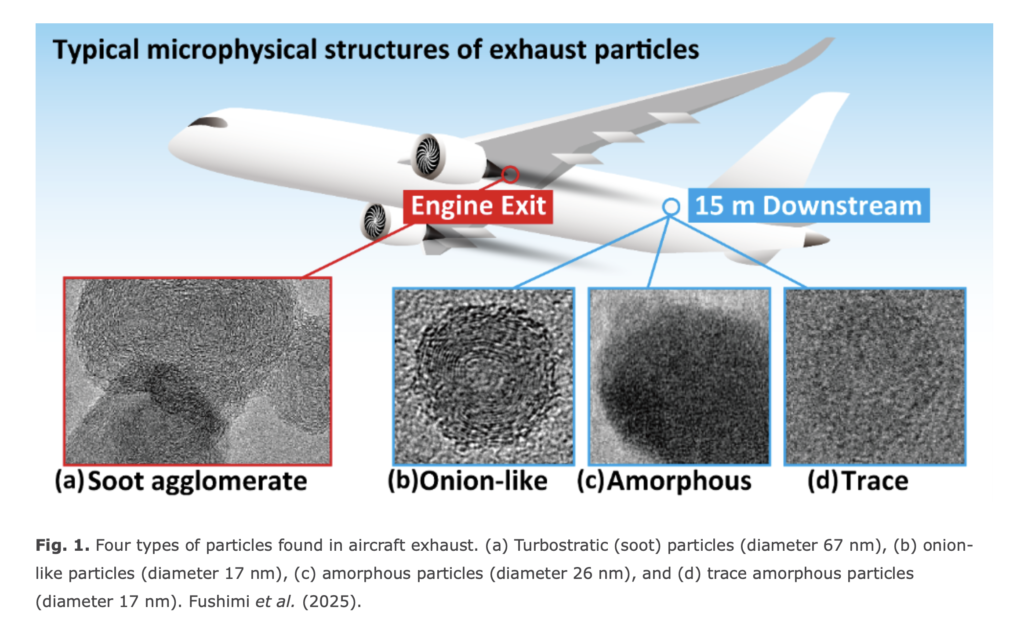
This image is from a 2025 study by Fushimi, who used high-resolution transmission electron microscopy and discovered the “onion-like” layers of the exhaust particles emitted by jet engines.
They confirmed that the formation of the ice nuclei occurs in layers formed by the metallic elements left by the coordination complexes after the MDA has burnt off.
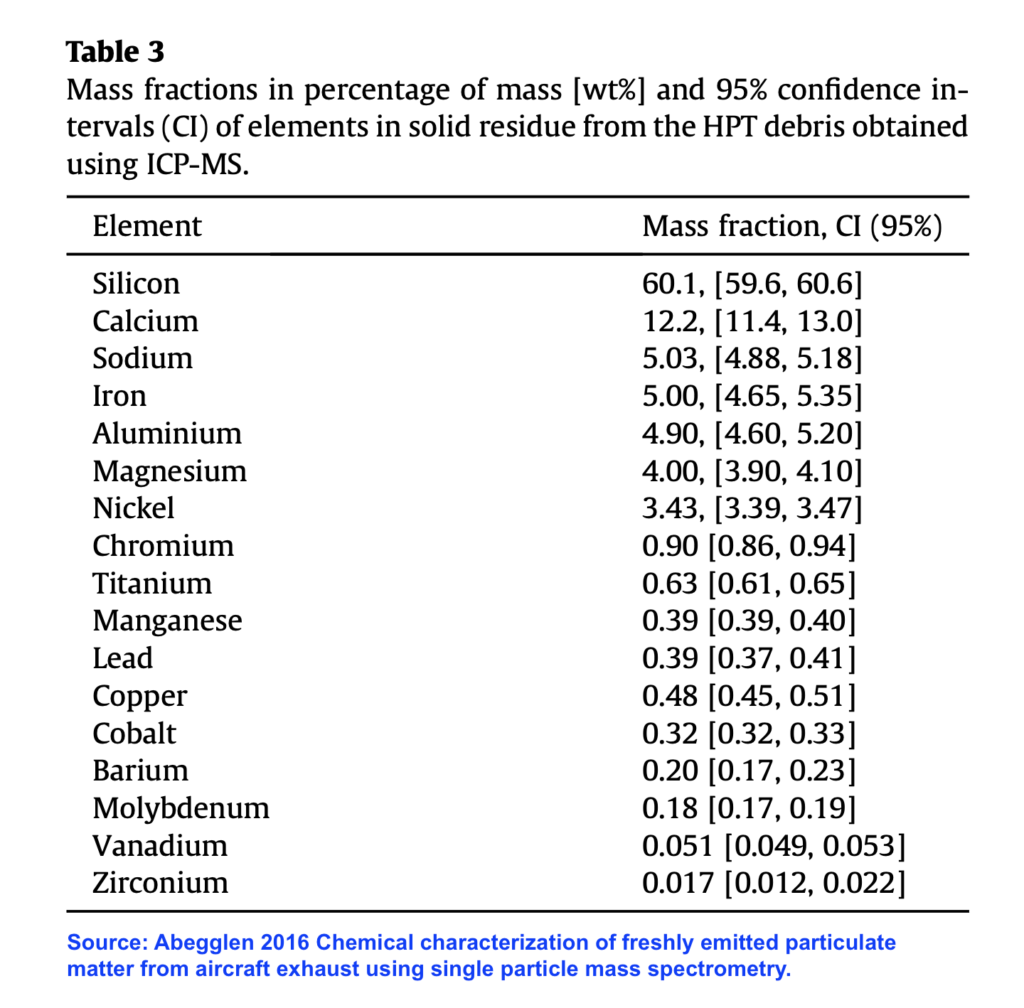
A 2016 study by Abegglen tested Jet A1 fuel.
They found Si, Ca, Na, Fe, Al, Mg, and Ni to make up almost all of the solid particulate matter in the exhaust plume.
While the engines add some contamination to the exhaust from wear and oil ingress, by far the largest percentage comes from the contaminants of jet fuel added from cracking and coking.
These metallic and silicon onion-like nuclei of non-combustibles dominate the solid particulate mass of the exhaust plume even though they are only present in trace amounts.
If jet fuel were pure kerosene, it would only produce gases and a small amount of carbon soot.
For each tonne of jet fuel burned, 1.24 tonnes of water and 3.15 tonnes of carbon dioxide are produced.
In total, approximately 4.4 tonnes of by-products form from each tonne of fuel.
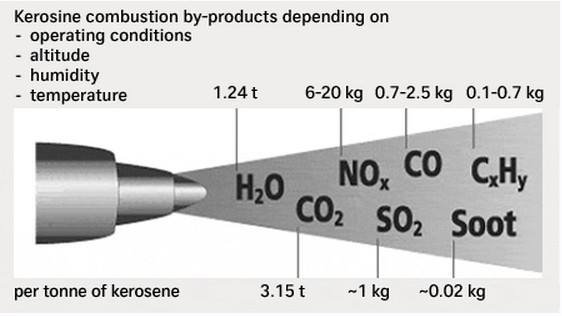
Jet engines turn fuel into massive amounts of water and carbon dioxide. They produce 1.24 times more water than the amount of fuel they consume.
In a way, they act as flying water-making machines, converting fuel into water as they go.