We all see trails growing in clear blue skies, and we know the importance of the saturation point.
Now we will learn what humidity was needed for trails to grow before the year 2,000.
An important point to understand about the science of contrails is that scientists divide their life into two distinct phases. When researchers talk about formation, they are referring only to the first one or two seconds after the exhaust leaves the engine, when hot exhaust gases mix with cold air and the initial droplets and ice crystals appear. When they talk about growth or evolution, they are describing everything that happens after this point, as the ice crystals grow, spread, or disappear depending on the surrounding atmosphere. A useful analogy is striking a match: formation is the moment the match lights, while growth describes whether the flame grows, flickers briefly, or goes out entirely.
Historical Modelling Using Physics
During World War II, the UK Air Force relied on the MINTRA line, a system based on thermodynamic principles first described by Schmidt in 1941. Schmidt’s research explained the physics of how aircraft could produce visible condensation trails. For pilots flying dangerous missions, understanding when these trails would form was critical: a visible trail could reveal an aircraft’s position to enemy forces, while accurate predictions could help crews avoid detection. Wartime observations confirmed that the models based on Schmidt’s principles were remarkably accurate under real-world conditions.
In 1953, Appleman built on Schmidt’s work, developing what became known as the Schmidt-Appleman criterion. His framework analysed how hot jet engine exhaust mixes with the surrounding air, taking into account air pressure, temperature, humidity, and entrainment, the process by which surrounding air is drawn into and mixes with the exhaust plume. By considering these factors, Appleman could predict exactly when and where a jet would produce a visible contrail. Importantly, his approach was general enough to apply to any jet aircraft, and his charts were later adopted by organisations including the US Air Force, showing how careful scientific research could be applied directly to operational decisions.
By linking careful observation, fundamental physics, and practical forecasting, Schmidt and Appleman laid the foundation for our modern understanding of contrail formation, knowledge that began in the high-stakes skies of wartime Europe and continues to guide aviation today.
Appleman also provided specific values for predicting when contrails would become visible, such as the minimum amount of water vapor needed in the air for a contrail to be seen. He determined that at typical cruising altitudes, the air needed to contain at least 0.01 grams of water per cubic meter for the contrail to be visible to the human eye.
Appleman’s framework gave scientists three basic rules for predicting contrail formation, along with precise measurements for each
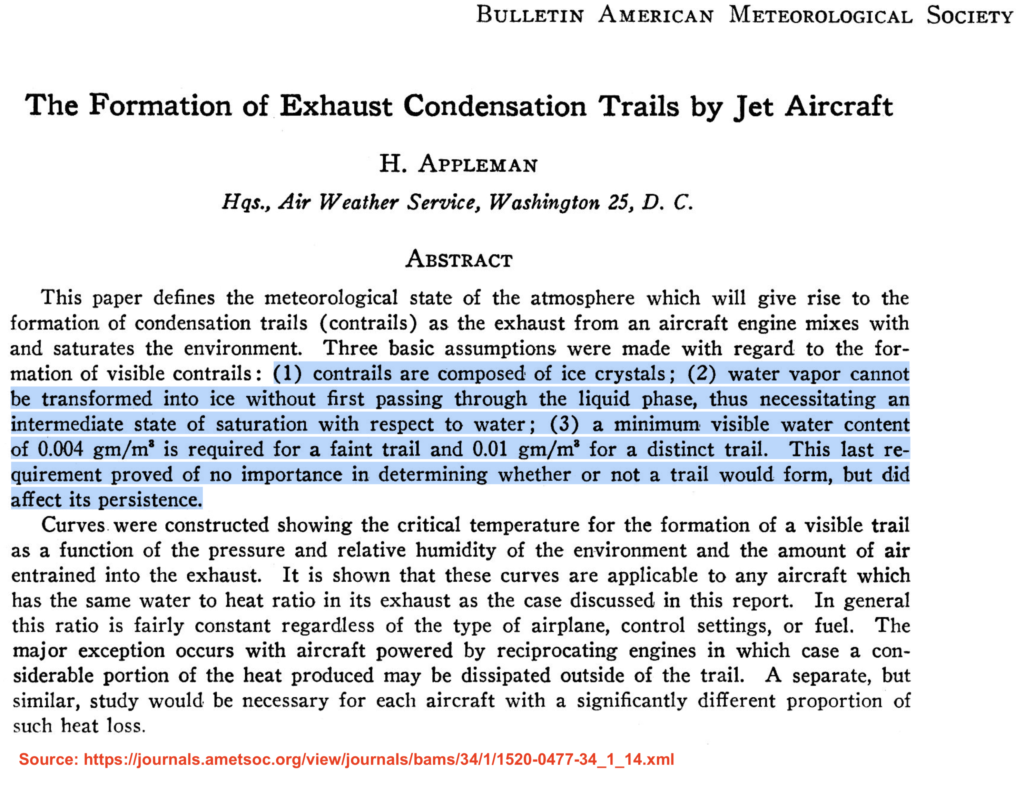
Rule 1: Contrails are made of ice crystals.
Rule 2: Ice crystals will only form if the exhaust mixes with highly supersaturated air, to ensure the relative humidity within the exhaust plume remains above 155%. Below this level, condensation and freezing cannot occur.
Rule 3: Contrails are visible only if there is enough water in the surrounding air, and Appleman even provided exact values for this minimum.
These rules were widely accepted by scientists at the time, and all subsequent research has built upon their foundations. Appleman’s theory also explained a key observation: contrails form at a distance behind the aircraft, not immediately at the engine exit. Right after leaving the engine, the exhaust is hot and unmixed, so water vapour cannot condense. It needs time to mix with the outside air. As the exhaust plume mixes with cold, humid air, the vapour can condense and freeze into ice crystals.
At typical cruise altitudes, a jet engine burns fuel at roughly 1,700 °C, releasing exhaust at about 550 °C into the surrounding air, which is very cold at around −55 °C. If the superheated water vapour freezes while still highly supersaturated, it will produce ice crystals without a dust particle as its nucleus. These initial ice crystals act as seeds on which more ice can grow, without any external ice nuclei to start the process. This explains why extremely low temperatures and high humidity are so critical for contrail formation: the vapour must freeze into ice before the plume falls below the supersaturation threshold. Early contrail research consistently confirmed this principle.
Decades later, large-scale observational campaigns provided opportunities to test and refine the Schmidt–Appleman framework. The POLINAT project (POLlution from aircraft emissions in the North ATlantic flight corridor) from 1994–1997, as well as NASA’s 1997 SONEX and SUCCESS campaigns, gathered extensive data on contrail formation, showing that the original thermodynamic principles identified by Schmidt and Appleman remain valid.
The modern understanding of contrails rests on a thermodynamic foundation established in the mid-20th century, which has since been tested, refined, and confirmed through decades of observations, experiments, and physics-based modelling. The original thermodynamic conditions identified by Schmidt and Appleman remain valid today.
Atmospheric science is a field with no competing theory: clouds are always made of water vapour. There is no such thing as a “dry cloud,” and all scientists agree on this fundamental fact.
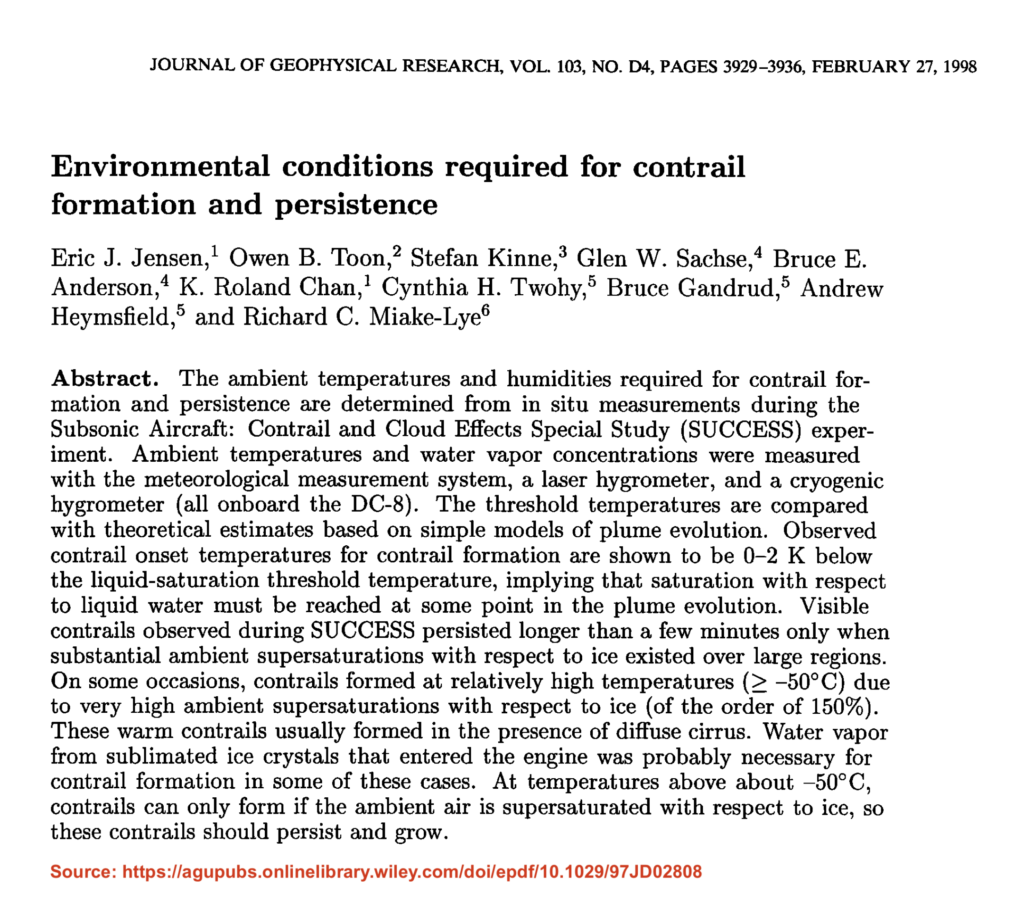
In 1996, NASA launched the SUCCESS campaign. For these studies, aircraft equipped with specialised sampling instruments were flown directly behind other planes leaving contrails to measure how they formed and evolved.
Jensen (1998), one of the lead authors of that campaign, tracked the growth of 20 contrails under different humidity conditions.
His results provided an important baseline for later studies.
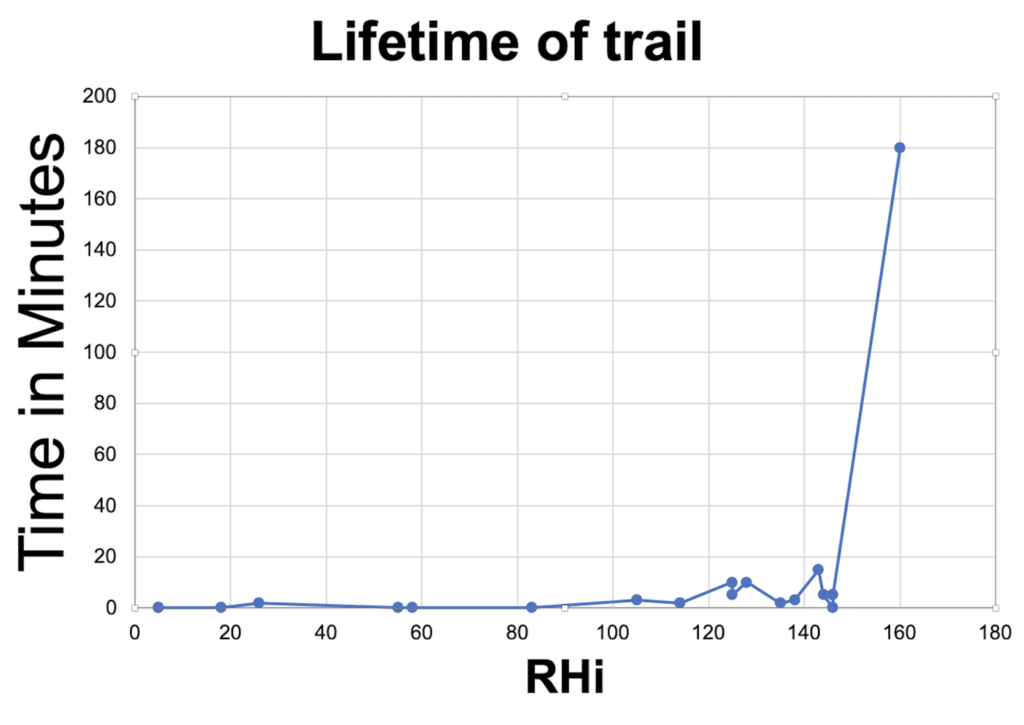
As shown in this graph of the Jensen recordings, contrails persisted briefly when the relative humidity exceeded 125%, but they grew substantially only when it was above 140%.
These findings align perfectly with all earlier research and highlight the critical role of high supersaturation in contrail formation, and subsequent growth.
All atmospheric scientists agree: contrails only grow into thick, lasting clouds at very high humidity, generally above 125%.
This is similar to the conditions required for natural cirrus clouds.
Neither natural cirrus nor contrails will form or grow in air that is too dry; high supersaturation is essential for visible cloud formation.
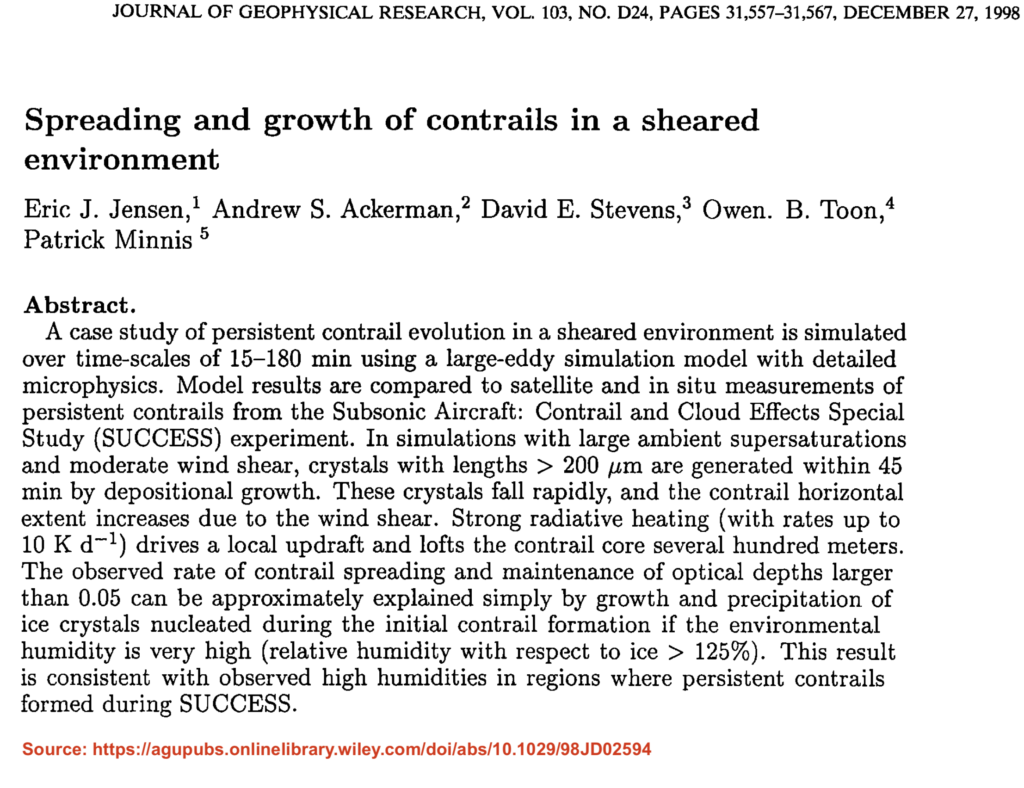
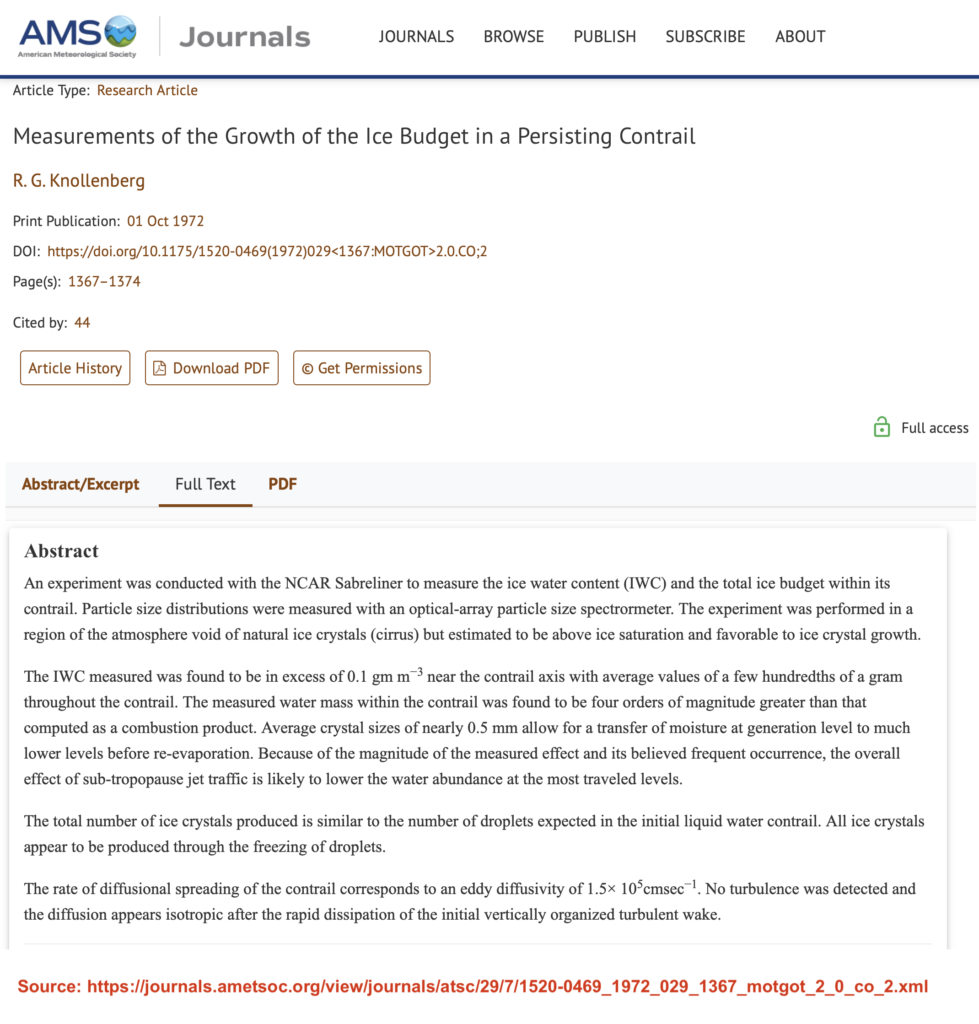
A 1972 study by Knollenberg measured how much a contrail could expand after leaving the engine.
He found that contrails could grow using the surrounding air’s moisture to become more than 15,000 times larger in under 30 minutes.
However, without sufficient humidity, the contrail quickly dispersed. Knollenberg observed that 20 minutes after a contrail had grown significantly, it completely disappeared when atmospheric conditions changed. This demonstrates that contrail persistence and growth rely entirely on the surrounding air, and they will dissipate quickly if the air later becomes subsaturated.
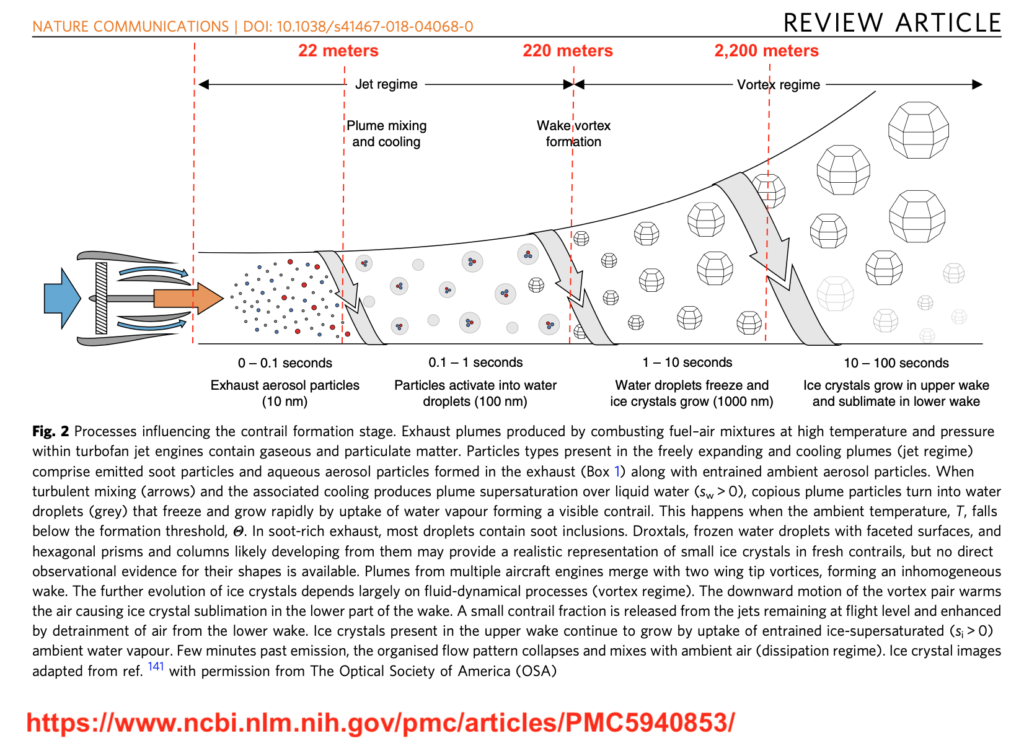
More recently, Karcher (2018) confirmed that Appleman’s thermodynamic model for contrail formation remains consistent with modern physics, laboratory experiments, and aircraft observations. His work also includes clear visuals showing the transition from engine exhaust to visible cloud; in the version shown here, the distances for a cruising airliner have been added in red to help illustrate the scale.
At a cruising speed of about 500 mph:
0–0.1 seconds (≈22 m, about half a plane length): The exhaust plume contains superheated water vapour and particles, but no contrail is visible.
0.1–1 seconds (≈22–220 m, roughly half a plane length to 3–4 plane lengths): Water vapour condenses into tiny liquid droplets, still invisible to the eye.
1–10 seconds (≈220 m+ – about 4 plane lengths and beyond): The droplets freeze into ice crystals, forming the visible contrail.
Summary of Contrail Physics
The modern understanding of contrails comes from the work of Schmidt and Appleman in the mid-20th century and has been confirmed by decades of observations and measurements. Contrails form only when hot engine exhaust mixes with very cold, highly supersaturated air.
For ice crystals to form directly from water vapour, the air inside the exhaust plume must remain highly supersaturated. This means the relative humidity of the exhaust plume must stay above about 155%. Below this level, ice crystals cannot form.
Once ice crystals form, their behaviour depends on the humidity of the surrounding air. They may persist briefly when humidity is above about 125%, but they grow into thick, long-lasting clouds only when humidity exceeds 140%. In drier air, contrails fade and disappear quickly.
These same physical rules explain why contrails do not appear immediately as they exit the engine. The exhaust must first mix with the cold outside air, so visible contrails usually appear some distance behind the aircraft after mixing has occurred. From wartime forecasting to modern field campaigns, this understanding of contrail formation and evolution has remained remarkably consistent for more than 80 years.