Key Takeaways
- Modern high-bypass turbofan engines do not explain the increase in persistent trails since the late 1990s.
- The difference in contrail formation temperature between old and new engines is only about 1.3 °C (from -39 °C to -37.7 °C).
- Commercial aircraft cruise at temperatures far below this threshold (typically -45 °C to -60 °C), so both old and new engines form trails whenever humidity conditions allow.
- Most airliners had already switched to high-bypass engines by the late 1970s — well before the noticeable increase in persistent trails.
- The real driver of more visible, longer-lasting trails in clear blue skies is changes in jet fuel composition, not engine design.
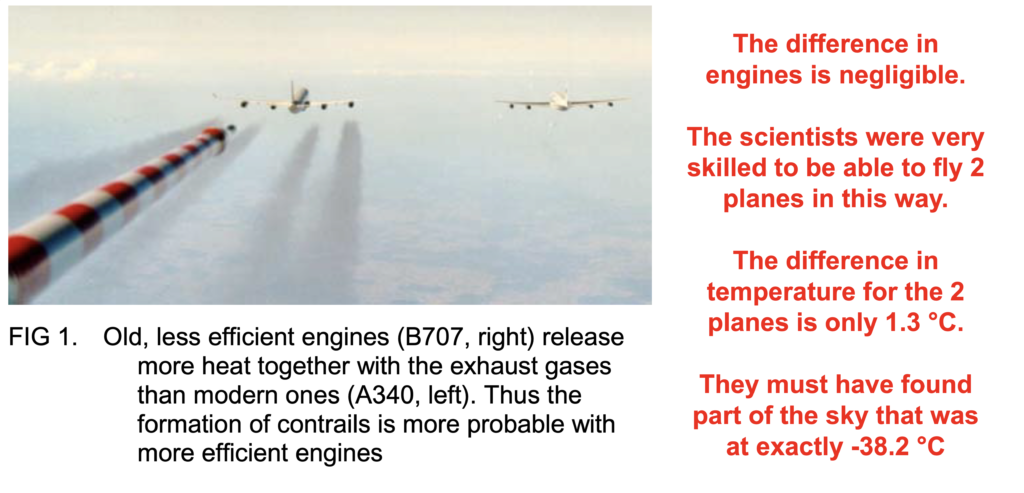
Much has been written about the idea that modern high-bypass turbofan engines are responsible for more persistent trails. A study by Schumann (2000) showed that the temperature threshold for trail formation has shifted only slightly, from approximately -39 °C to -37.7 °C, a difference of just 1.3 °C.
Commercial aircraft typically cruise at much colder temperatures (around -45 °C to -60 °C). In this range, both old and new engines will form trails whenever the humidity is high enough. The small change in formation threshold only affects a narrow band of marginal conditions and has very little practical impact on most flights.
Furthermore, the transition from low-bypass to high-bypass turbofan engines was largely complete by the late 1970s. The noticeable increase in persistent trails began decades later, in the late 1990s. This timeline does not support the idea that engine design is the main cause.
The efficiency improvement (from η = 0.23 to η = 0.31) is modest and occurs well below the temperatures where most trails form. In real-world operations, engine type is far less important than fuel composition.
−38 °C occurs at roughly 8.8–9.2 km (about 29,000–30,000 ft).
−50 °C occurs around 10.5–11 km (about 35,000–36,000 ft).
- Short flights: often 30,000–34,000 ft
- Medium-haul flights: commonly 34,000–37,000 ft
- Long-haul flights: often 35,000–39,000 ft, sometimes up to 41,000 ft for aircraft certified to fly that high
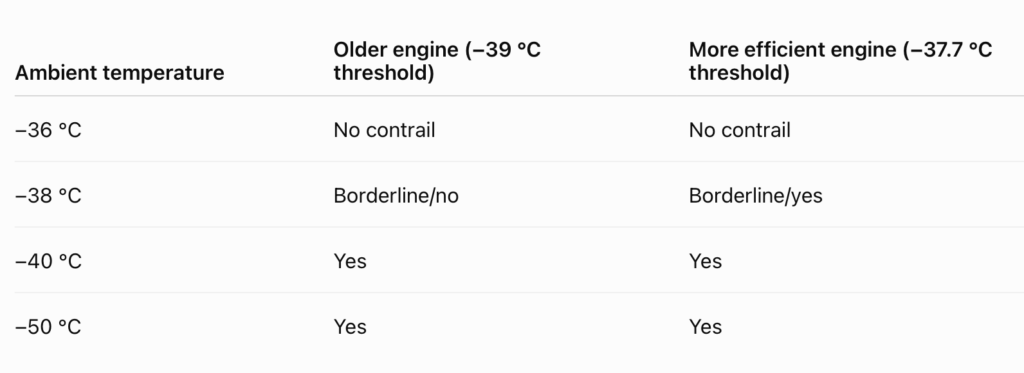
Since commercial aircraft usually cruise in air that is 10–20 °C colder than that threshold, the difference has very little real-world effect.